
When to go
Best Time to Rent a Car in New Zealand: Month by Month
Peak, shoulder and quiet months for a New Zealand road trip — with official visitor numbers and temperatures, and when to book your rental car.
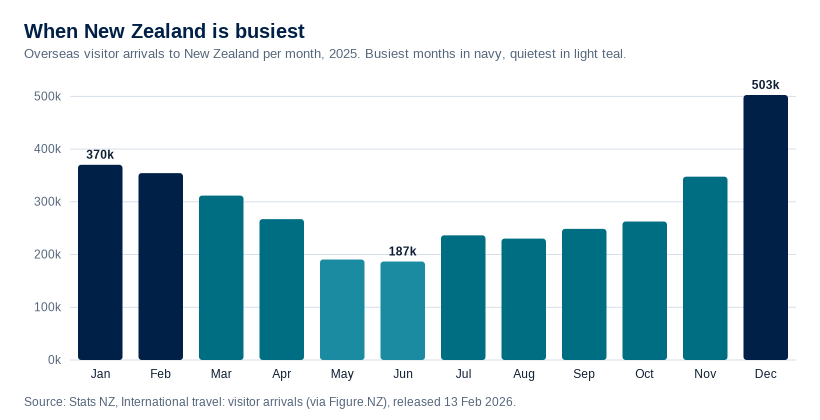
December to February is peak season: in 2025, 502,640 visitors arrived in December alone — about 2.7 times as many as in June. Rental cars, ferries and motels fill up first then, so book early. March–April and October–November are the sweet spot: fewer crowds, long days and mostly open roads. May to August is quietest and often cheapest, but alpine passes can need snow chains.
When is New Zealand busiest?
Visitor numbers follow the Southern Hemisphere summer. December is by far the busiest month, January and February stay high, and May and June are the quietest. More visitors means fewer cars left on the lot and higher daily rates, so the month you travel affects both availability and price.
| Season | Months | Visitors (2025) | On the road | Book your car |
|---|---|---|---|---|
| Peak summer | Dec–Feb | 354,000–503,000 a month | Long days, busy roads near Queenstown, Rotorua and the Coromandel; ferries full | 3–6 months ahead, especially vans and automatics |
| Autumn shoulder | Mar–Apr | 267,000–312,000 | Settled weather, autumn colours in Central Otago, Easter is busy | 4–8 weeks ahead; book Easter and school holidays earlier |
| Winter | May–Aug | 187,000–237,000 | Snow on alpine passes; ski crowds in Queenstown and Wānaka in July | Usually easy, except ski-season weekends in Queenstown |
| Spring shoulder | Sep–Nov | 249,000–348,000 | Lambs and lupins; late snow possible on passes into October | 4–8 weeks ahead |
How warm is it where you’re driving?
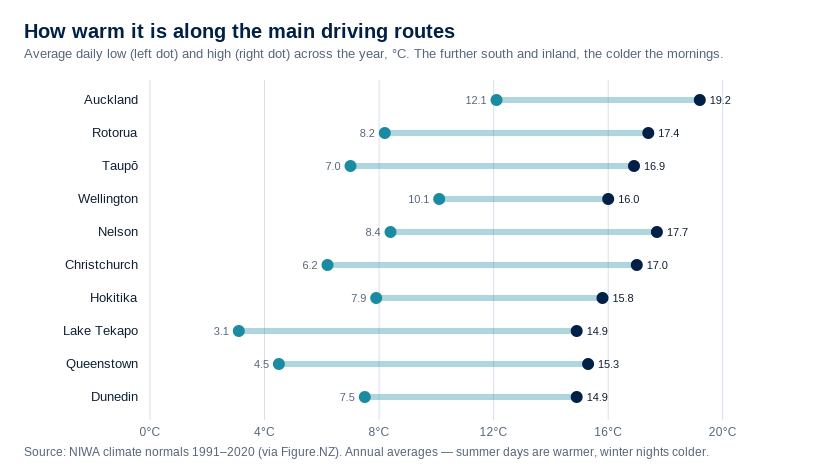
The gap between north and south matters more than most visitors expect. Auckland’s average daily low across the year is 12.1 °C; Lake Tekapo’s is 3.1 °C. If you’re driving the South Island outside summer, expect cold, possibly icy mornings inland — leave later, and ask the rental desk about snow chains.
Month-by-month tips
- December–January: school summer holidays in New Zealand too. Book the car, ferry and accommodation together, as early as you can. Christmas Day and New Year’s Day affect branch opening hours.
- February: still summer, slightly fewer families. Good for the West Coast and Abel Tasman.
- March–April: many people’s favourite time for a road trip. Watch for Easter — it moves each year and fills rental fleets.
- May–June: the quietest months and often the cheapest daily rates. Shorter days: plan to arrive before dark.
- July–August: ski season. Book a car with snow chains or a 4WD/AWD for the Crown Range, Arthur’s Pass or Mount Hutt access roads. Read winter driving in New Zealand.
- September–November: spring. Weather changes quickly; the Milford Road can still close for avalanche risk early in the season.
Does renting for longer save money?
Usually, yes — the daily rate tends to drop for rentals of a week or more, and more again for a month. If you’re staying several weeks, compare a long-term rental with a series of shorter ones.
- Stats NZ — International travel: visitor arrivals (via Figure.NZ)
- NIWA climate normals 1991–2020 (via Figure.NZ)
- NZ Transport Agency — Journey Planner
Checked November 2026. Rules change — always confirm with the official source and your rental company's terms.
Traveller toolkit
Driving in New Zealand: rules & trip tools
Quick checks based on New Zealand's official driving rules — so there are no surprises at the rental desk or on the road.
- 50Towns and citiesUsual limit in urban areas — some streets are lower.
- 100Most open roads & motorwaysThe maximum on most rural highways.
- 110Some expresswaysOnly where signs show 110.
- 20Passing a stopped school busIn either direction, while children may be getting on or off.
Speed limits are in kilometres per hour and can change along a road — always follow the posted signs.
- Keep leftDrive on the left side of the road and keep left unless passing.
- Alcohol limitsDrivers 20 and over: 250 mcg per litre of breath (50 mg per 100 ml of blood). Drivers under 20: zero.
- Seatbelts & childrenEveryone must wear a seatbelt. Children under 7 must be in an approved child restraint — ask for one when you book.
- No hand-held phonesUsing a hand-held mobile phone while driving is illegal — use hands-free or pull over.
- Carry your licenceKeep your licence (and translation or IDP if needed) with you whenever you drive.
- One-lane bridgesMany rural bridges are one lane. If the red (smaller) arrow points your way, give way to oncoming traffic.
- Take breaksLong drives are tiring — stop for a break about every 2 hours.
- Fuel & distancesFuel is sold by the litre and distances are in kilometres. Fill up before remote stretches — stations can be far apart.
Sources: Tourism New Zealand — driving licences & permits · Ministry of Transport — drink-driving limits · NZ Transport Agency — Road Code. A general guide, not legal advice.
Compare car hire in New Zealand
Search every rental company we work with — the final price, what's included and the rental terms are shown before you pay.