
- Close Icon
- Car Rental Locations
- Manage Booking
- Contact Us
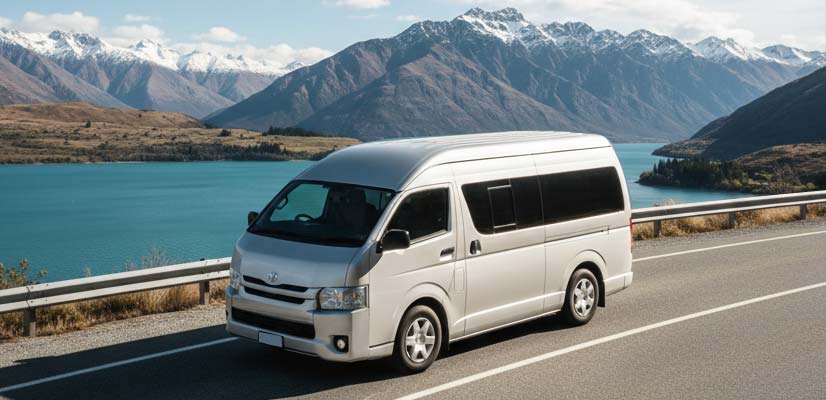
The unmatched space and comfort make the Toyota HiAce one of the go-to mobility solutions for travelling together with large groups in New Zealand. Choosing a suitable van from different Hiace models with specific features, luggage capacity, and 8-12 seating options can be confusing for many. Read this guide to learn everything about renting a Toyota HiAce van in NZ. We have compiled typical average costs, seating layouts, add-ons, requirements and how a HiAce compares with other vehicles to help you make the best decision when booking.
Toyota HiAce vans are highly valued for offering comfortable rides to large families, tour groups, and business travellers in New Zealand. The ample room for luggage and gear makes them perfect for long road trips. Often available in fuel-efficient diesel and petrol options, Hiaces are versatile modes of transportation. These make them ideal to deliver comfort, stability, and performance for intercity drives and alpine routes.
Read the table below to understand the key specifications for most Toyota HiAce rentals in New Zealand.
| Category | Key Details |
|---|---|
| Engine & Fuel | – 2.8L diesel (most common) – Some older models 2.7L petrol – Diesel models can incur RUC |
| Transmission | Automatic & Manual |
| Seating Capacity | 10–12 seats, depending on model |
| Luggage Space | 4–6 large bags + soft bags (varies by seat layout) |
| Drive Type | – RWD (standard) – 4WD variants depending on supplier |
| Fuel Efficiency | Moderate; depends on model and engine type |
| Tech & Convenience | – Bluetooth/USB – Apple CarPlay, Parking sensors (newer models) |
| Rental Suitability | Ideal for group travel, tours, sports teams, large families |
The most common HiAce variants offered by location and supplier rental fleets across New Zealand include:
▪️ 10-12 Seater Hiace (Commuter/GL/ZX)
These are the larger commuter vans or basically minibuses that work well for airport transfers, group tours, and events where luggage space matters. Travellers who need to move a full group without splitting vehicles usually opt for these models.
▪️ 8-10 Seater HiAce (Granvia / Regius Ace)
A bit smaller and easier to park, especially in areas where multi-storey carparks have tight ramps. Good fit for families who still want plenty of room but don’t need a high-roof minibus.
▪️ Automatic & Manual (All Models)
Automatic vans are more common and easier on NZ’s hilly roads. Manual options do exist, but only on select models and often in limited stock, so checking ahead of time is suggested.
While the base price for hiring a Toyota Hiace in New Zealand varies depending on the chosen supplier, location, and season, the average daily and weekly booking costs for different models are:
NZ charges diesel, EVs, and plug-in hybrid vehicles that do not pay tax through fuel excise duty. For diesel vehicles under 3.5 tonnes, such as the Toyota HiAce, RUC is charged per kilometre travelled.
Since most Toyota HiAce vans in New Zealand run on diesel, they are subject to the Road User Charges. Rental companies usually arrange an RUC licence for 1,000 km in advance or charge you for the actual kilometres travelled when you return the vehicle.
Most rental deals include standard insurance such as Collision Damage Waiver, Theft Protection, and Third Party Liability, but the excess amount may still be high. You can choose optional coverage, such as Super CDW or Full Protection, to partially or fully reduce potential damage costs.
A security deposit is an amount of money held by the supplier on the primary driver’s credit card at pickup. The amount can change by rental provider, vehicle, and insurance. Provided you return the van in its original condition, the full deposit is refunded.
Companies charge an extra fee for adding extra drivers to a HiAce rental in New Zealand. A first additional driver may be allowed at no extra cost in some deals; charges for each added driver usually apply. Any extra drivers are subject to the same age and licence requirements as the main driver. If applicable, the company will also charge young driver fees.
Travellers in New Zealand often hire Toyota HiAce vans for flexible one-way trips across different locations. They can simply pick up the vehicle at one point and drop it off at another without making a return trip. However, a drop-off fee is usually charged based on the distance, selected vehicle, and the rental provider.
Some suppliers permit taking the HiAce for ferry crossings and inter-island travel, while others may not. You can either
Keep in mind that service is available upon request only. You must read the policies and confirm with the supplier before booking.
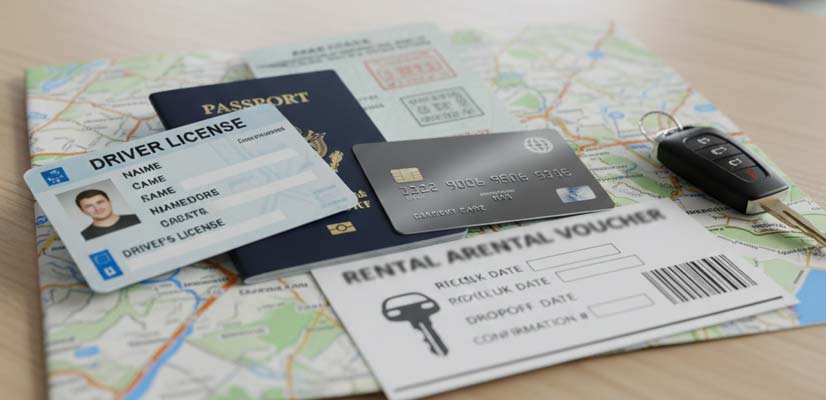
You must meet the following conditions to rent a Toyota HiAce in New Zealand. If any of the requirement is not met, the supplier may cancel or mark your booking as ‘No Show’.
Drivers must be at least 21 years old to book a HiAce rental. Some companies may accept older drivers for large-sized vehicles. A Young Driver Surcharge applies to drivers under 25 in such cases. Always confirm eligibility before making a reservation.
An original driver’s licence held for at least 12 months is required to hire a van in NZ. Foreign licences issued in a non-Roman alphabet (eg, Arabic, Chinese) must be accompanied by an International Driving Permit (IDP) or a certified English translation when picking up the vehicle.
A national ID or passport is required for a rental provider to verify your booking at the time of pickup. Your supplier may deny the van if any necessary documentation is missing.
Nearly all companies require a valid credit card in the main driver’s name to hold a mandatory security deposit to ensure the financial safety of their vehicles during the booking period. The deposit amount is released in full once the Hiace is returned without any tickets and in the same condition as you picked it up.
A rental or booking voucher is generated once your booking is confirmed. It usually contains all the necessary details about your hired vehicle, inclusions, price breakdown, and related terms and conditions. Your supplier will refer to this document during pickup.
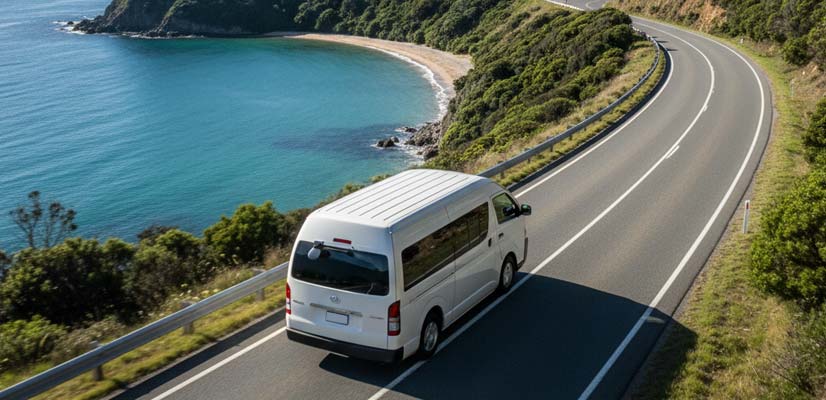
Driving a Hiace can feel different at first for those who have only driven compact or standard-sized cars. Remember the following points for driving in NZ:
Most Hiace variants are categorised as light motor vehicles and follow the standard speed limits in New Zealand:
Pay attention to local signposts to maintain a safe speed and avoid traffic violations.
Driving a large vehicle like the HiAce for long-distance road trips in New Zealand requires extra planning. Experienced travellers recommend the following driving tips:
➜ Expect fewer fuel stations on long South Island routes.
➜ Hiace vans are taller and heavier, requiring you to use lower gears on steep downhill stretches and to slow down when taking corners.
➜ Keep your large and heavy bags low and forward in luggage space for stability.
➜ Switch places with other extra drivers every 2-3 hours to avoid extreme fatigue.
➜ Carry snow chains in winter to travel across alpine passes. You can also check road and weather conditions with NZTA and MetService to plan your route more efficiently.
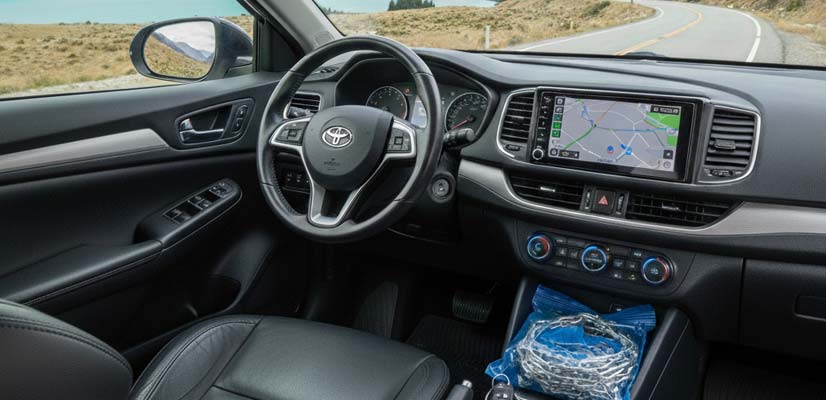
The Toyota HiAce vans in New Zealand are available with a range of optional extras to ensure a comfortable and smooth travel experience for all passengers. Availability varies by location and supplier, but some of the standard options added by travellers are:
Driving & Convenience
Winter & Outdoor Travel
Family Travel
A majority of the travellers arrive in New Zealand at the following locations, making them convenient points for picking up a HiAce van. These are major points with maximum availability and offer fast and easy access to nearby attractions.
Refer to the following table to understand the usability of a HiAce rental in New Zealand and whether it will meet your travel requirements.
| ✅ Pros | ⛔ Cons |
|---|---|
| ✔️ Spacious seating ✔️ Ample luggage space ✔️ Suitable for families/groups ✔️ Good for cost-sharing ✔️ Widely available on both islands ✔️ Automatic variants for comfortable handling ✔️ Better visibility |
❌ Challenging to park ❌ Diesel vans may incur distance fees ❌ Difficult manoeuvring on steep roads ❌ Higher fuel costs |
No, you can drive most 10-12 seater HiAce vans in New Zealand using a standard full car licence. But you must meet the rental provider’s age and driver’s licence requirements.
Diesel Hiace models are usually more fuel-efficient and cheaper, especially for long road trips. But factors like road usage charges can bring about additional costs. Allow extra budget for unexpended expenses when planning your itinerary.
Although the 10-seater and 12-seater Toyota Hiace models are quite common options in New Zealand, you may also find suppliers offering passenger vans with up to 14 seats.
You may include child seats or booster cushions when booking, but they may not be suitable for all rows. Additionally, children under 7 years old are legally prohibited from sitting in the front row of a vehicle in New Zealand. If travelling with infants or young kids, make sure to confirm availability when booking.
While one-way rentals are usually not permitted by various suppliers, you may be able to book with select suppliers upon prior approval and additional restrictions. You will also be required to pay a drop-off fee and purchase Interislander ferry tickets to take the van from one island to another.
Yes, a majority of recent HiAce models available for rent in New Zealand are automatic. You can choose a preferred transmission from the manual and automatic options when booking.
As long as you drive cautiously, it is safe to drive a Hiace in the New Zealand Alps. Since most drivers are familiar with standard cars, it is necessary to be mindful of sharp bends, narrow roads, and wet causeways.
Folding or removing the seats of a hired Toyota HiAce is typically not allowed by suppliers due to safety and insurance reasons. Even so, some models may be offered with foldable last rows. If you need a van with foldable seats, confirm availability with the rental company before finalising the booking to avoid any disagreements.
RUC payments are usually made in advance, allowing cars to be driven a certain distance. If applicable, rental companies will either charge you upfront or bill you based on the odometer reading at drop-off.
You can avail of after-hours pick-ups with multiple companies in New Zealand, but service availability differs by location and supplier policies. Some rental counters may have dedicated key boxes, while others have company staff available for assistance. These services are only provided upon request at an additional fee.
No, driving a large 12-seater van on high-risk roads like Skippers Canyon, Ninety Mile Beach, Ball Hut, and parts of Coromandel is not permitted by rental companies. Taking the vehicle to restricted areas would violate the rental agreement and insurance policies.
You are not allowed to sleep in the 8-12 seater Toyota Hiace rentals offered in NZ because they are standard passenger vans. Travellers can sit or rest during the trip, but they cannot use the vehicle for overnight sleeping. You will need a self-contained campervan for camping or sleeping inside the vehicle.