
Before you pay
Rental Car Insurance and Excess in New Zealand Explained
How rental car excess works in New Zealand, the three levels of cover, common exclusions and whether your travel insurance already covers you.
Every New Zealand rental includes basic damage and theft cover, but with an excess — the most you pay if the car is damaged or stolen. You can pay a daily fee to reduce it (Apex, for example, offers a reduction to NZ$1,000) or to remove it. Some damage is often not covered at all, whatever you buy: GO Rentals, for example, holds hirers liable for all underbody damage and bans named unsealed roads. Travel insurance can cover the excess instead, but check the limit — Consumer NZ found policies covering anywhere from $3,000 to $10,000.
What is the excess?
The excess (called a deductible in some countries) is the most you pay towards damage to the rental car, or if it is stolen, under the cover included in your rental. If the repair costs less than the excess, you pay the repair cost; if it costs more, you pay the excess and the cover pays the rest. The amount depends on the company and the car — larger and premium cars usually carry a higher excess. It is shown in the Rental Terms before you pay.
Many companies also hold a bond on the main driver’s credit card at pick-up. It is released after you return the car — GO Rentals, for example, says this typically takes 5–10 business days. Damage is deducted from the bond.
The three levels of cover
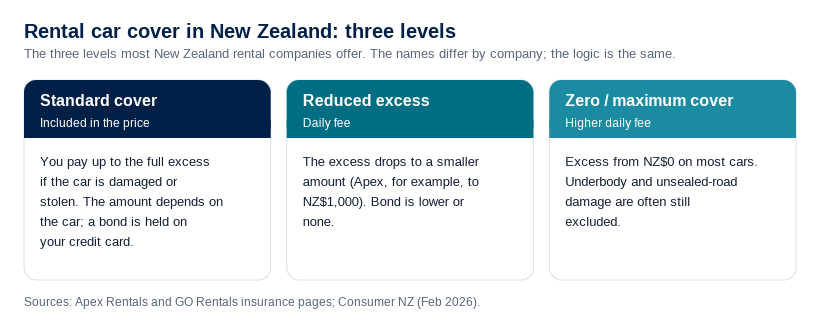
| Standard | Reduced excess | Zero / maximum | |
|---|---|---|---|
| Cost | Included | Daily fee | Higher daily fee |
| Excess | Full amount for the car | Lower (e.g. NZ$1,000 at Apex) | From NZ$0 on most cars |
| Bond | Usually held on a credit card | Lower or none | Often none; some accept debit cards |
| Best for | Travellers whose travel insurance covers rental excess | A balance of price and peace of mind | Long trips, gravel driveways, nervous drivers |
What usually isn’t covered
Read this part of the Rental Terms carefully — exclusions apply even when you buy zero-excess cover.
- Underbody damage. GO Rentals, for example, makes hirers liable for all underbody damage.
- Unsealed and banned roads. Named roads are commonly banned, such as Skippers Road, Ninety Mile Beach, Te Paki Stream, Ball Hut Road and the Macetown road, along with beaches and unformed tracks. Damage there is usually not covered. See driving on gravel roads.
- Windscreens and tyres — covered by some companies (GO includes them), excluded or limited by others.
- Breaking the rental agreement — an unlisted driver, alcohol, or taking the car on the ferry when the company doesn’t allow it can void the cover entirely.
Is travel insurance enough?
It can be. Many travel insurance policies include “rental vehicle excess” cover, so you can decline the rental company’s reduction and claim back any excess you pay. Two things to check:
- The limit. Consumer NZ found excess cover in travel policies ranging from about $3,000 to $10,000. It must be at least as high as the rental excess.
- The exclusions. Some policies exclude tyres and windscreens, and you still pay the rental company first, then claim. Your own policy excess (often a few hundred dollars) also applies.
Credit-card cover works the same way: check the limit and whether New Zealand rentals are included.
At the rental desk
- Bring a credit card in the main driver’s name if you chose standard cover — it’s needed for the bond.
- Photograph the car all round, including wheels and windscreen, before you leave, and note any marks on the condition report.
- Do the same when you return it, especially at an after-hours drop-off.
- Drivers under 25 often pay a young-driver fee and may face a higher excess — see renting a car under 25.
- Consumer NZ — Should you pay to reduce your rental car excess? (Feb 2026)
- Apex Rentals — Excess reduction cover
- GO Rentals — Rental car insurance options
Checked November 2026. Rules change — always confirm with the official source and your rental company's terms.
Compare car hire in New Zealand
Search every rental company we work with — the final price, what's included and the rental terms are shown before you pay.