
Drive safely
Road Safety for Visiting Drivers in New Zealand: Facts and Rules
Official crash statistics for overseas drivers in New Zealand, the road rules that catch visitors out, and a checklist for your first day at the wheel.
Overseas drivers are not the main cause of crashes in New Zealand: in 2015–2019 they were involved in 5.7% of fatal and injury crashes, according to the NZ Transport Agency — and "involved" doesn't mean at fault. The risks for visitors are specific: driving on the left, narrow winding roads, one-lane bridges, tiredness after a long flight, and underestimating travel times. Keep left, take breaks every two hours, and plan shorter driving days than you would at home.
What the numbers say
The NZ Transport Agency publishes crash data for drivers on overseas licences. Between 2015 and 2019:
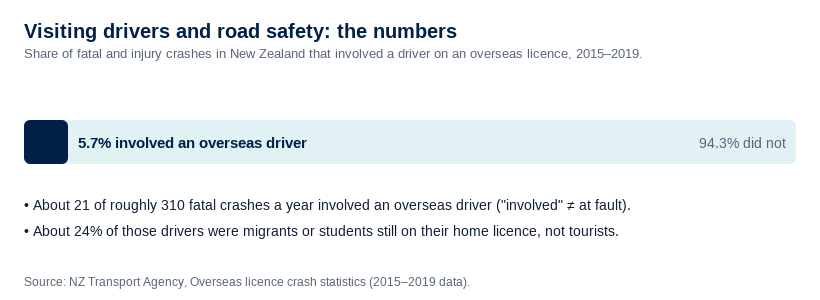
- 5.7% of fatal and injury crashes involved a driver on an overseas licence.
- About 21 of roughly 310 fatal crashes a year involved an overseas driver. In 2019 it was 9 of 300.
- About a quarter of those drivers weren’t tourists at all — they were migrants or students still on their home licence.
NZTA notes it doesn’t know how much driving visitors do, so a crash rate per kilometre can’t be worked out. The takeaway isn’t that visitors are dangerous — it’s that the same few situations cause most of the problems.
Rules that catch visitors out
| Rule | What to do |
|---|---|
| Keep left | Drive on the left. At every turn and roundabout, say “left, left, left” until it’s automatic. Roundabouts go clockwise; give way to traffic from your right. |
| Speed limits | Most open roads 100 km/h, some expressways 110 km/h where signed, towns usually 50 km/h or less. Many rural roads have lower limits — follow the signs, not the maximum. |
| School buses | 20 km/h passing a stopped school bus, in either direction. |
| One-lane bridges | A round sign with a red border means you give way to oncoming traffic; a blue rectangular sign with a large white arrow means you have priority — but still check the bridge is clear. |
| No-passing lines | Don’t cross a solid yellow line on your side of the centre line. Wait for a passing lane. |
| Alcohol | Drivers 20 and over: 250 micrograms per litre of breath (0.05 blood alcohol). Under 20: zero. Safest is not to drink at all if you’re driving. |
| Phones | No handheld phone use while driving, including at traffic lights. Use a cradle and set the route before you start. |
| Seatbelts and child seats | Everyone wears a seatbelt. Children under 7 must be in an approved child restraint — book one with the car. |
Your first day behind the wheel
- Don’t drive far straight off a long flight. Jet lag and driving on the left don’t mix. If you land at Auckland Airport after a long-haul flight, keep day one short.
- Get used to the car in the car park — indicators are often on the right stalk, so expect to switch on the wipers by mistake.
- Plan for slower travel. 60–80 km/h is a realistic average on most highways. See road trip itineraries for sensible daily distances.
- Pull over to let traffic pass. If a queue builds behind you, use the next safe pull-over area.
- Check the road on the NZTA Journey Planner before mountain passes and in winter.
- Emergency: dial 111 for police, fire or ambulance.
Your licence
You can drive on a current overseas car licence for up to 18 months from your arrival. If it isn’t in English, you also need an approved English translation or an International Driving Permit. Full details: driving in New Zealand with a foreign licence.
- NZ Transport Agency — Overseas licence crash statistics
- NZ Transport Agency — The official New Zealand road code
- Ministry of Transport — Drink-driving limits
- NZ Transport Agency — Journey Planner
Checked November 2026. Rules change — always confirm with the official source and your rental company's terms.
Traveller toolkit
Driving in New Zealand: rules & trip tools
Quick checks based on New Zealand's official driving rules — so there are no surprises at the rental desk or on the road.
- 50Towns and citiesUsual limit in urban areas — some streets are lower.
- 100Most open roads & motorwaysThe maximum on most rural highways.
- 110Some expresswaysOnly where signs show 110.
- 20Passing a stopped school busIn either direction, while children may be getting on or off.
Speed limits are in kilometres per hour and can change along a road — always follow the posted signs.
- Keep leftDrive on the left side of the road and keep left unless passing.
- Alcohol limitsDrivers 20 and over: 250 mcg per litre of breath (50 mg per 100 ml of blood). Drivers under 20: zero.
- Seatbelts & childrenEveryone must wear a seatbelt. Children under 7 must be in an approved child restraint — ask for one when you book.
- No hand-held phonesUsing a hand-held mobile phone while driving is illegal — use hands-free or pull over.
- Carry your licenceKeep your licence (and translation or IDP if needed) with you whenever you drive.
- One-lane bridgesMany rural bridges are one lane. If the red (smaller) arrow points your way, give way to oncoming traffic.
- Take breaksLong drives are tiring — stop for a break about every 2 hours.
- Fuel & distancesFuel is sold by the litre and distances are in kilometres. Fill up before remote stretches — stations can be far apart.
Sources: Tourism New Zealand — driving licences & permits · Ministry of Transport — drink-driving limits · NZ Transport Agency — Road Code. A general guide, not legal advice.
Compare car hire in New Zealand
Search every rental company we work with — the final price, what's included and the rental terms are shown before you pay.